EarthQuaker Issue 102
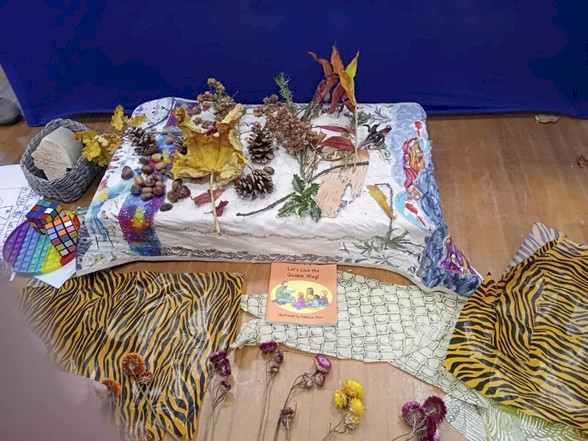
During the residential weekend at Swanwick, Bernie led an all age activity on the Saturday afternoon about “noticing”. We went outside into the grounds around the Centre and, together, we slowed down and really noticed our “earth companions”: leaves, fungi, bark, stone, soil, all sorts of things. It was a quiet and spiritually inspiring space to be “in the moment”, really focussed on life going on all around us.
Since returning home I have come across an “encounter” practice given by Susannah Brindle in Kinship with Creation a publication by Quaker Green Action in 2002. It very much chimes with Bernie’s session and it might be of interest to some Friends as a practice to explore and adapt as you wish.
Encounter
- Wherever you live, whether in the country or the city, become aware of living things other than human. Venture perhaps beyond the familiar and let your consciousness be attracted to beings you have not paid attention to before. Maybe the moss growing in the pavement at your front gate, or a tree you have taken for granted. (Remember that from a tree’s perspective it may not be appropriate to be too effusive on your first meeting!)
- Pay attention to this being. Give it your time, notice how it is formed, learn its name if you don’t already know it. Be still with it so that you can begin to sense its presence. Leaving behind your preconceptions about this being, try to accord it the respect you would bring to a person you had just been introduced to. Discover its intrinsic beauty. Know that this being is made, like you, “in the image of God” and, again like you, imbued with divine Spirit. Speak to it and address it as “brother” or “sister”.
- Become aware of how you feel towards this creature now that you have acknowledged a mutual kinship. In ways that seem appropriate, nurture your relationship with this being whenever possible.
- Begin to make the acquaintance of another creature in the same way. This time you may choose someone more difficult to interface with – a persistent weed, perhaps, or an insect you formerly considered a pest.
She goes on to say “The above are only offered as ‘a bit of a start’ because each one of us has a uniquely different relationship with Earth. Earth has an infinity of voices which will speak to you in the sounds, textures, fragrances, tastes, images, thoughts, dreams and connections that mean most to you.”
Kathryn May
(appeared as an Appendix, page 37/38, Kinship with Creation - Two Quakers Share Their Views - Susannah Brindle and Alastair McIntosh - publisher Quaker Green Action 2002 ISBN 0 9518766 3 5)