Asked what Quakers have in common, some Friends say “we believe there is that of God in every one”; others point to Quaker worship or Testimony. Often, there are dissenters from any generalisation. I’ve experienced many attempts to find unity among Quakers and others. Mostly they’ve involved some combination of:
- A story about who we are, our past, our future, what we are for, perhaps a view of the world, and a theory of change.
- Inclusivity and experiences of relatedness to one another, to other communities, and the more-than-human world.
- Collaboration in some kind of action, shared practice, or way of life.
Often there are frustrations where participants give priority to one of these, and are impatient with other approaches.
At our Earthcare Gathering last year, we stuck with the “Open Space” format of previous gatherings, with the planning group providing the container and encouraging participants to provide and shape the content. There was opportunity for worship, for emotional sharing and support, for art and other creative practices, and for discussion of ideas and practical actions. We managed to include more Friends who usually find it hard to attend – especially young adults and children with their parents. With 114 Friends present, we had a huge range of interests and priorities. Perhaps the strongest tension – as nearly always when we address the Earth crisis – was between calls for urgent action and a calling to slow down and be present to ourselves, each other, and all life.
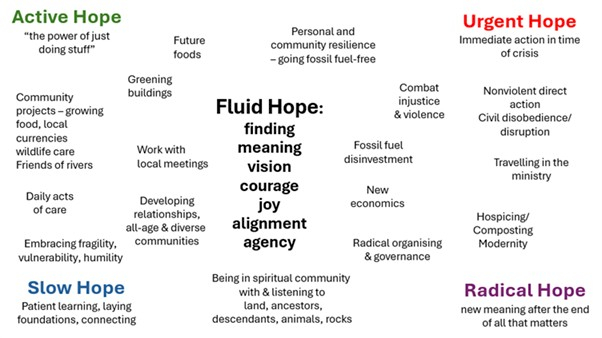
In a recent “Your Brain on Climate” podcast, Dave Powell interviewed Pancho Lewis about his paper on “Fluid Hope”, considering different ways we sustain ourselves and our sense of agency in the climate crisis. His typology of hope includes “urgent”, “slow”, and “radical” hope. In the figure below I’ve had a go (you could probably do better!) at mapping some of the concerns Friends brought to the Earthcare Gathering, with different kinds of hope as attractors. I’ve also included Chris Johnstone and Joanna Macy’s idea of “Active Hope”.
None of these forms of hope excludes the others. We may mix them or move among them in our lives and communities. My own experience has been of periods of strong purpose – shared with at least some other people – interspersed with episodes of floundering, lacking clarity about my role or my community. I started out in renewable energy research. I moved to climate policy analysis and advocacy, then to grassroots experiments with lifestyle and cultural change, and to bringing Quaker disciplines to bear in seeking ways forward. In each of these, I had a sense of problems to be solved so that humans and all life might flourish. The urgency varied, depending a lot on the context – the state of the public discourse at the time; my own sense of being able to make a difference. Now, in these strange times, I am increasingly trying to recognise how I am part of, or at least entangled with, the problems.
Laurie Michaelis